
Digital Strain at the Workplace: Why Computer Vision Glasses are More Important Than Ever Today
Relief for the eyes: Why computer vision glasses are indispensable even in modern industrial manufacturing and logistics.
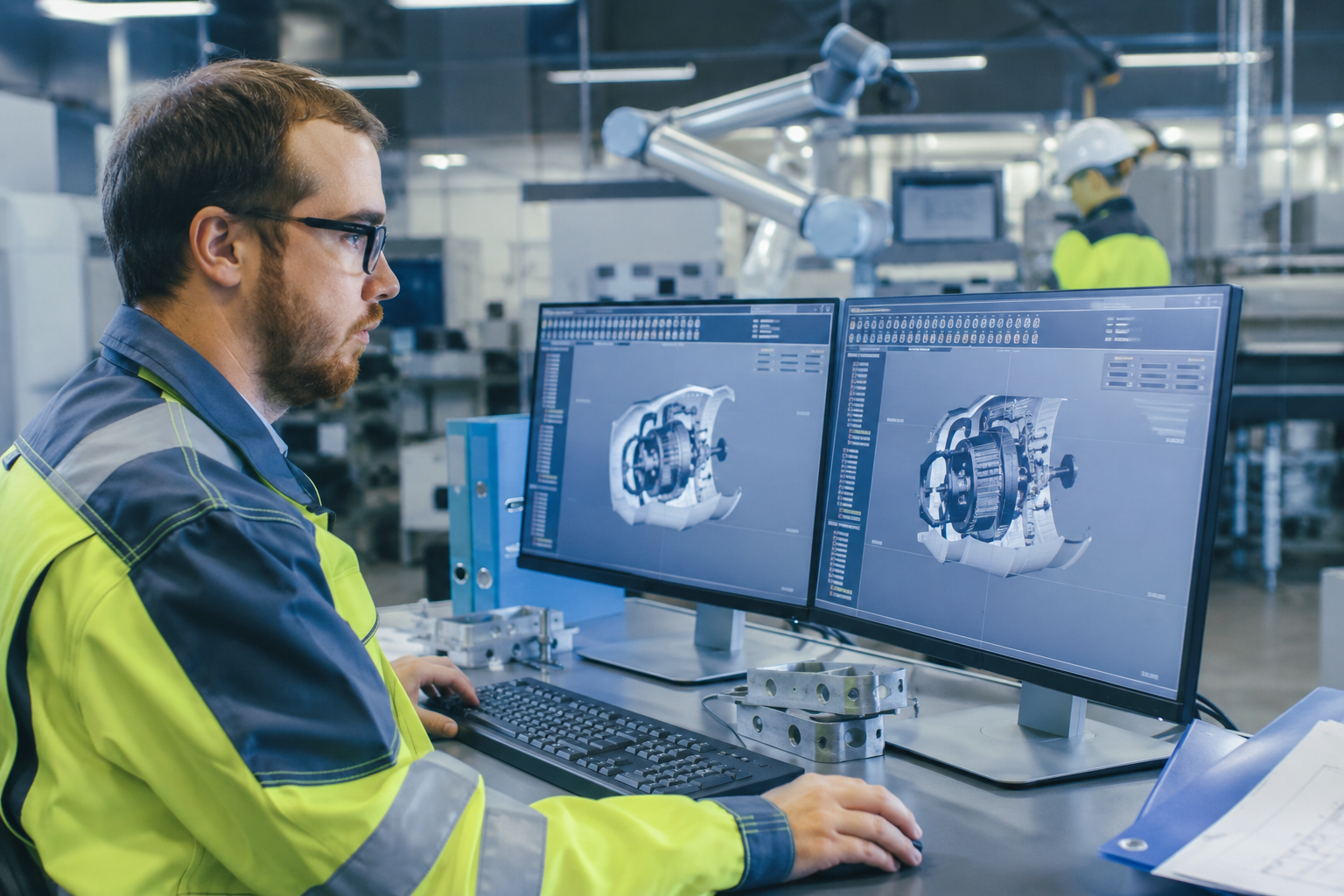
Digitalization is rapidly changing our working world. Not only traditional office workplaces, but also production facilities, logistics centers, laboratories, and technical workplaces are now characterized by monitors, tablets, and digital control systems. This also increases the demands on the human eye.
Modern computer vision glasses ensure relaxed vision at the actually required working distances and make an important contribution to ergonomics, health, and productivity. The special feature: The same lens technology can be used in both classic computer vision glasses and corrected safety glasses. This way, employees – regardless of their workplace – always receive the optimal vision solution.
Computer work takes place everywhere today – not just in the office
With digitalization and Industry 4.0, everyday work has fundamentally changed. Digital information now accompanies almost every work step.
While in the past mainly office workers regularly worked in front of screens, digital displays and computer systems are now just as much a part of everyday life in many areas:
- Production and manufacturing: Digital control panels as standard
- Quality control: Switching focus between workpiece and monitor
- Logistics and warehousing: Data entry on scanners and displays
- Laboratories: Working with digital analysis devices
- Maintenance and repair: Use of tablets and tools
- Technical service departments: Mobile access to data
- Design and development: Intensive work with CAD software
- Purchasing and administration: Classic ERP and PC workstations
Whether machine control, ERP system, CAD software, measuring station, or tablet – modern workplaces require constant switching between different viewing distances.
For example, a quality inspector continuously switches focus between the workpiece, measuring device, and screen. A service technician works simultaneously with tools and a tablet. Employees in logistics record data on scanners and check information on displays. Even in production, digital control panels have long been standard.
Precisely this permanent switching between different distances poses great challenges for the eye.
Why normal glasses are often not enough
Many employees use their private reading glasses or conventional progressive lenses at work. However, both solutions are only partially suitable for modern computer workstations.
Reading glasses are usually designed for a distance of around 40 centimeters. However, monitors are often located between 70 centimeters and 1.5 meters away.
Progressive lenses cover all distances, but often have only a narrow viewing channel in the so-called intermediate area. This means that the head and neck must be constantly moved to find the optimal viewing area.
Many employees are familiar with the consequences:
- Headaches: Frequent consequence of muscle overload
- Eye discomfort: Dry or burning eyes
- Tension: Pain in the neck and shoulder area
- Fatigue: Rapid decrease in concentration throughout the day
- Visual acuity: Declining visual performance over the course of the day
Especially in activities that require precision and attention, these complaints directly affect work quality.
Digital eye strain – an underestimated stress factor
The constant switching between screen, documents, tools, and workpieces puts a considerable strain on the eyes. Experts refer to this as Computer Vision Syndrome (CVS) or digital eye strain.
The most common symptoms include:
- Headaches: Due to constant overexertion of focusing
- Dry eyes: Or excessive tearing due to reduced blinking
- Blurred vision: Slowed focusing when changing distances
- Light sensitivity: Glare from bright displays and LED light
- Muscle tension: Forced postures in the shoulder and neck area
These complaints not only impair well-being but can also increase the error rate and negatively affect occupational safety, especially in production, laboratories, or quality control.
Computer vision glasses – developed for modern workplaces
Computer vision glasses – often also called computer glasses or office glasses – are individually adapted to the actual viewing distances of the respective workplace.
Depending on the activity, the optimal viewing range is between approximately 40 centimeters and two meters. This allows the screen, keyboard, documents, workpieces, or conversation partners to be seen comfortably and without constant refocusing.
The advantages are clearly noticeable:
- Posture: Relaxed head and neck posture
- Viewing areas: Significantly larger fields of vision than with progressive lenses
- Relief: Reduced strain on eyes and muscles
- Performance: Higher concentration throughout the entire workday
- Efficiency: More precise and faster work
One lens technology – two areas of application
Many people associate computer vision glasses exclusively with office workplaces. In fact, the same ergonomic lens technology is used today in very different work environments.
In workplaces without mandatory safety glasses, the specially adapted office lenses are used in high-quality office or computer vision frames.
If, on the other hand, safety glasses are mandatory, the same lenses can be integrated into corrected safety glasses. Employees thus benefit simultaneously from optimal visual comfort and standard-compliant eye protection.
This means:
| Work Environment | Recommended Solution | | --- | --- | | Office and Administration | Computer vision glasses | | Design and CAD | Computer vision glasses | | Purchasing and Administration | Computer vision glasses | | Laboratory | Computer vision glasses or corrected safety glasses | | Quality Control | Corrected safety glasses with computer vision lenses | | Production | Corrected safety glasses with computer vision lenses | | Logistics | Computer vision glasses or safety glasses depending on risk assessment | | Maintenance and Service | Individually adapted computer vision or safety glasses |
The decisive factor is therefore not the frame, but the optimal adaptation of the lenses to the actual visual tasks.
Additional lens options for even more visual comfort
Depending on the workplace, various lens options can further improve visual comfort.
High-quality anti-reflective coatings reduce annoying reflections from LED lighting, windows, or machine surfaces.
Modern filter technologies can reduce disturbing light components from digital screens and increase visual comfort during intensive screen work.
For workplaces with mandatory safety glasses, these properties are combined with the requirements for personal eye protection (e.g., according to EN 166). The safety glasses used naturally comply with the applicable standards and at the same time offer the same ergonomic lens technology as classic computer vision glasses.
Legal basis: When does the employer cover the costs?
Many companies are unaware that computer vision glasses are legally regulated.
Both in Switzerland and within the European Union, there are regulations for health protection at computer workstations. Employees are entitled to an eye examination if they regularly work with display screen equipment.
If this examination shows that special computer vision glasses are necessary and ordinary everyday glasses do not sufficiently fulfill the visual task, the employer – depending on the respective legal provisions and company regulations – covers the costs entirely or partially.
For companies, a structured supply process is worthwhile. This ensures that both ergonomic requirements and economic aspects are optimally considered.
Computer vision glasses as part of modern health management
More and more companies consider ergonomic vision as an integral part of their occupational health management.
Because good vision means:
- Complaints: Significantly fewer physical symptoms
- Absenteeism: Lower absenteeism among the workforce
- Concentration: Consistently high focus performance
- Error rate: Noticeably fewer input and control errors
- Productivity: Higher employee satisfaction and efficiency
Especially in view of an aging workforce, the optimal provision of computer vision glasses is becoming increasingly important.
Unico Graber – Individual vision solutions for every workplace
Every workplace places different demands on vision. Therefore, Unico Graber does not rely on standard solutions, but on individually adapted office lenses.
Whether classic computer vision glasses for office, administration or design, or corrected safety glasses for production, laboratory or quality control – the underlying lens technology is precisely adapted to the respective visual tasks.
This provides companies with a consistent solution for all computer workstations – regardless of whether safety glasses are mandatory or not.
Conclusion
Digital workplaces are now found everywhere. The demands on the human eye are therefore constantly increasing.
Individually adapted computer vision glasses improve visual comfort, reduce physical complaints, and support concentrated work. If safety glasses must also be worn, the same ergonomic lens technology can be integrated into corrected safety glasses.
This allows companies to benefit from a uniform solution for all computer workstations – in the office as well as in production, logistics, laboratories, or quality control. Because good vision is not a luxury, but an essential prerequisite for health, productivity, and occupational safety.