
Over-the-glasses safety goggles or prescription safety glasses? The honest comparison for companies
Employees with visual impairments need good visual comfort and reliable eye protection at the workplace. The comparison between over-the-glasses safety goggles and individually corrected safety glasses shows which solution is economically and safety-wise convincing.
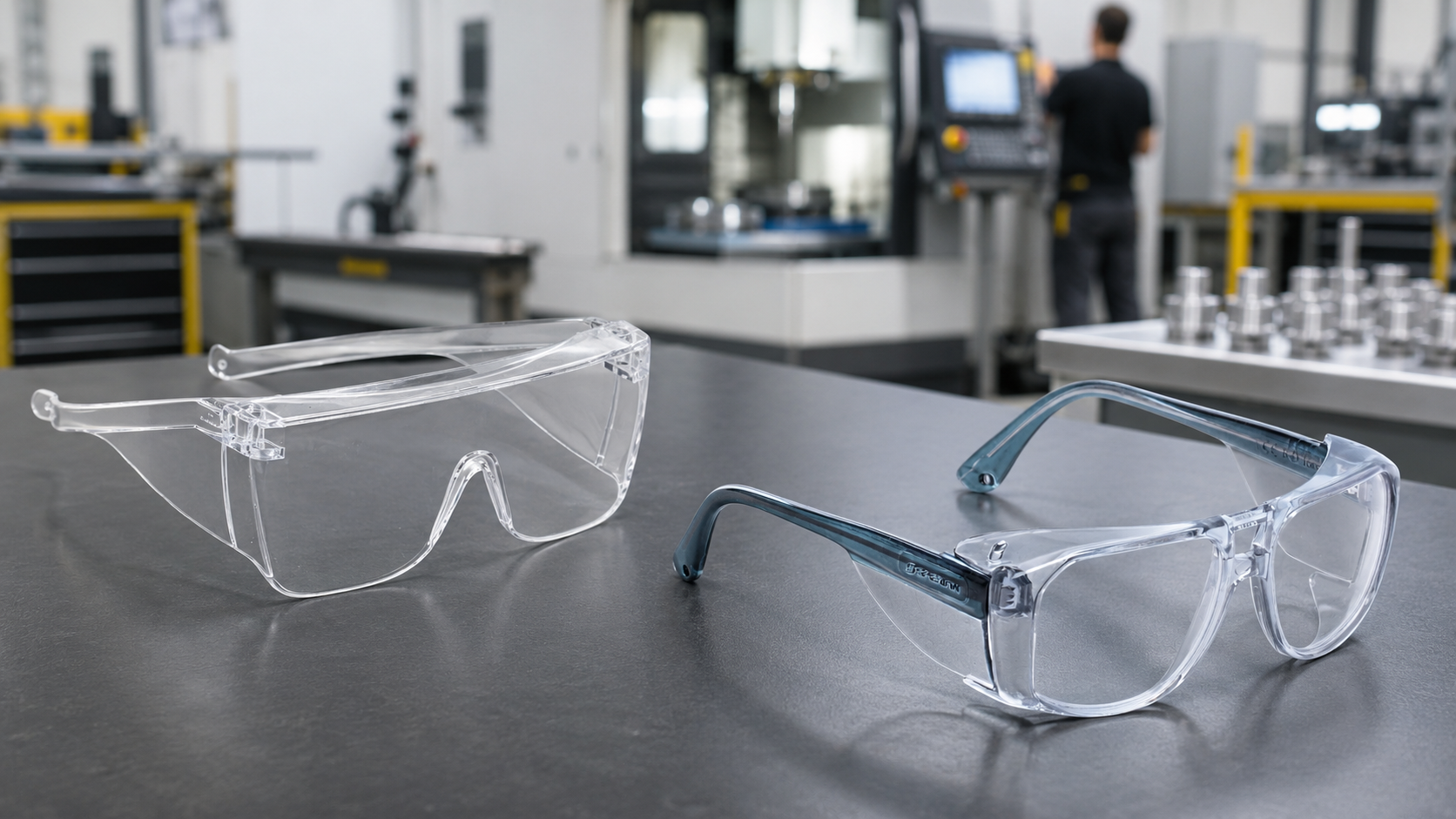
When it comes to employees with visual impairments, companies often face the question: Are over-the-glasses safety goggles sufficient, or are prescription safety glasses the better choice? The answer depends on wearing duration, conditions of use, and ergonomic requirements. A structured comparison shows that the cheapest purchase is not automatically the most economical solution.
Why normal prescription glasses are not enough
While standard everyday glasses correct visual acuity, they offer no protection against mechanical, chemical, or optical hazards. Foreign bodies and splinters can damage lenses or penetrate unimpeded from the side.
Suva also makes it clear: Normal vision aids have no protective effect. Where eye protection is mandatory, certified personal protective equipment (PPE) according to EN 166 must be worn.
When are over-the-glasses safety goggles useful?
Over-the-glasses safety goggles are worn directly over private vision aids. They score points for quick availability and low acquisition costs.
This solution is particularly useful in the following scenarios:
- Occasional use: For short-term activities in hazardous areas.
- Visitor protection: Provision for guests, customers, or external personnel.
- Temporary solution: Bridging the gap until definitive prescription safety glasses are provided.
Disadvantages of over-the-glasses safety goggles in daily work
Anyone wearing two pairs of glasses quickly reaches their limits during longer periods of use. The additional weight burdens the nose and ears, while double reflections impair the field of vision.
An overview of typical weaknesses:
- Wearing comfort: High weight and painful pressure points with longer wearing duration.
- Optical limitations: Disturbing reflections between lens surfaces and reduced field of vision.
- Practical hurdles: Increased fogging of lenses and possible slipping during movement.
- PPE compatibility: Difficult to combine with helmets, respirators, or hearing protection.
What distinguishes prescription safety glasses?
Prescription safety glasses combine visual acuity and protective function in a tested product. The lenses are precisely matched to individual vision performance and the specific requirements of the workplace.
Key advantages in daily use:
- Highest comfort: Significantly lower weight and optimal fit without pressure points.
- Clear vision: Individually adapted single vision or multifocal lenses for all viewing distances.
- Maximum safety: Wide field of vision and seamless integration into existing PPE.
- High acceptance: Readily and consistently worn by employees.
Comfort as an operational safety factor
For safety glasses, ergonomics is not a luxury but an essential safety factor. Glasses that pinch or fog up are often removed in practice – often at precisely the wrong moment.
Only when eye protection is worn continuously does it fulfill its preventive function. Good wearing comfort directly increases wearing acceptance and sustainably reduces the risk of eye accidents.
Economic efficiency: Acquisition price vs. total costs
In terms of pure purchase price, over-the-glasses safety goggles are cheaper. However, for a sound economic analysis, the total costs over the entire service life must be considered.
Companies should factor in the following points:
- Daily wearing duration: With continuous use, prescription safety glasses quickly pay for themselves.
- Work productivity: Fewer interruptions due to fogging or readjustment.
- Follow-up costs: Avoidance of expensive downtime and treatments due to eye injuries.
- Protection of private glasses: Damage to expensive everyday glasses is avoided.
Workplace analysis and individual lens selection
Every workplace places specific demands on vision – whether reading instruments or looking into the distance.
Professional consultation therefore includes:
- Hazard assessment: Comparison with relevant standards such as EN 166, EN 170, or EN 172.
- Viewing distances: Matching the lenses to the exact working distances.
- Environmental conditions: Selection of suitable coatings against fogging and scratches.
Efficient supply with Unico Graber
The provision of prescription safety glasses can be implemented simply and structured within a company. Unico Graber offers flexible supply channels.
Options for your company:
- Partner network: Professional fitting by qualified opticians.
- On-site service: Eye test, consultation, and fitting directly at your company.
- UNICO connect: Digital platform for easy processing of approvals, appointment bookings, and orders.
Conclusion: Usage decides
For visitors and short-term use, over-the-glasses safety goggles remain a practical choice. However, as soon as eye protection is required daily, prescription safety glasses represent the superior and more economical solution.
They ensure the best visual acuity, high comfort, and thus consistent compliance with the protection obligation. Unico Graber comprehensively supports you in the selection and organization of your prescription eye protection. See individually. Protect reliably.